
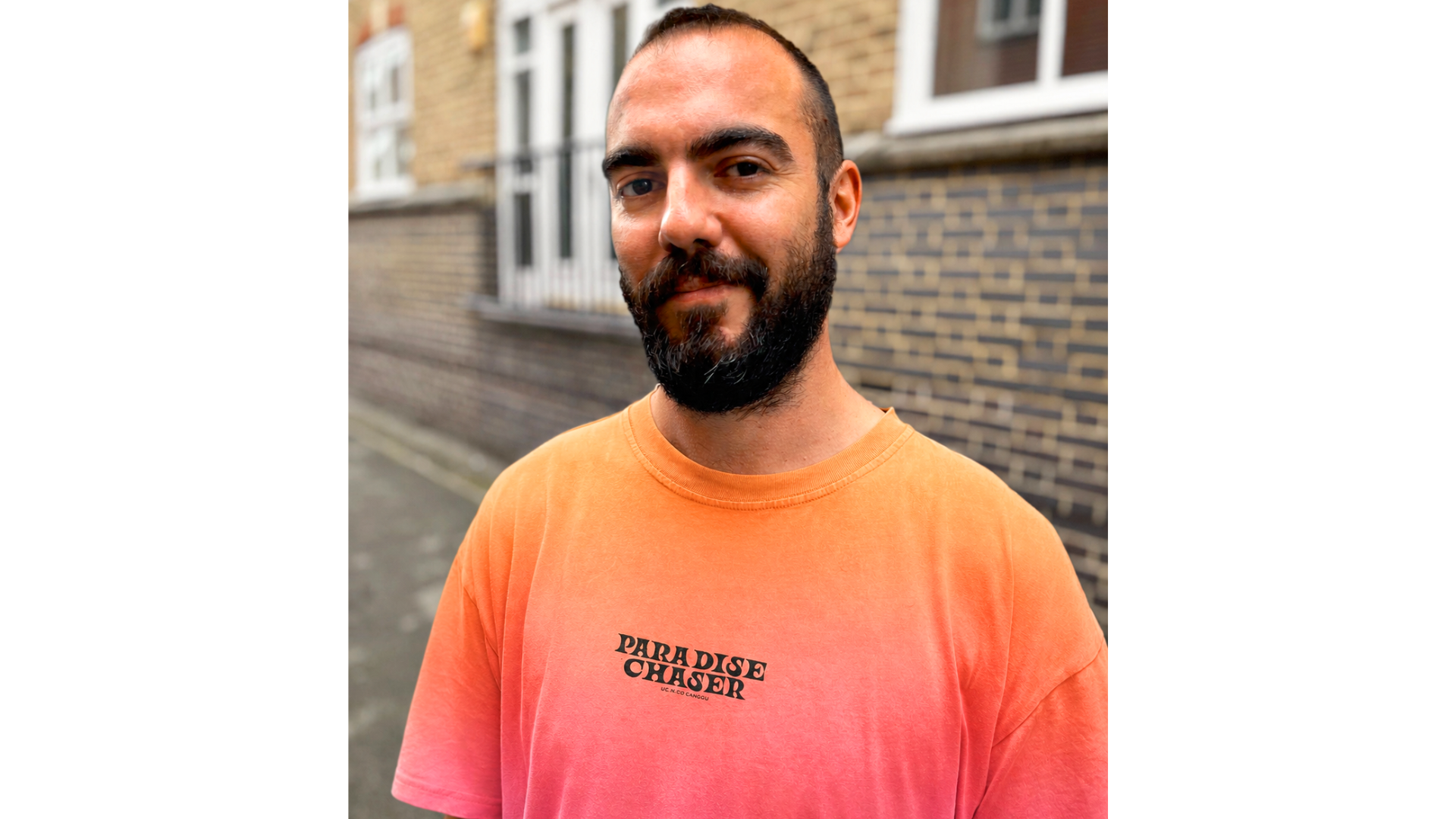
Scroll down to the bottom of Fernando Casado’s email signature, and you’ll find a line that describes him as We Are Collider’s “resident colour lover.” And Fernando (Fer to those in the know), really has had a colourful career. Since starting out a decade ago, he has built up a multidisciplinary design practice spanning digital, print, and illustration with work that blends bold visual thinking with purposeful design.
We caught up with Fer to talk about evolving from aesthetics to intention, designing for real human connection, and the cultural influences that shape his creative approach.
You’ve been designing professionally since 2017. How has your creative approach evolved, and what still excites you most about the process?
When I first started, it was all about looks, looks, looks. All I really cared about was making something striking, strong and visually appealing. Over time, however, that ethos has shifted significantly. Now, when I come to a design brief, I think much more about purpose. What does the design need to do? Who is it for? How does it actually work? My academic background is in fine art, which has a very different mindset, so over my career, I’ve had to learn that it’s not just about expression, but communication.
What really excites me most now is the process of turning an idea into something real. Working in something as tangible as experiential design, you actually get to see the work out in the real world, and that moment when something moves from an idea into a physical experience is always really rewarding.
Where does your love of colour come from?
That’s the million-dollar question. Honestly, I’m not really sure. Colour isn’t something I overthink. I’ve always found it quite intuitive, like it’s always been there. Even when I look back at the scribbles I made as a kid, the palettes are surprisingly similar to what I’d use now. My background in fine art definitely helped develop that, but it also comes from being in a very creative family.
Everyone in my family is very hands-on. My dad used to paint, my sister draws, my aunts make clothes, and everyone was always working on something. When you’re working on personal projects, it’s easy to go all in: bright, bold, expressive. By (‘scuse the pun) contrast, when you’re designing for a client, it’s a lot more about balance. Sometimes that means pushing colour to create something that feels energetic and expressive. Other times, it’s about holding back so the message comes through more clearly. Basically, it’s less about what I want to do personally with colour in a given moment and more about what the project requires.
As a multidisciplinary designer, half the job is balancing creativity with practicality. How do you approach a concept when it needs to work as hard as it looks?
For me, I always begin with purpose. Looks are great, but if you start there, you’ll get yourself into a real mess. I always try to understand what the work actually needs to achieve, and that means thinking about the audience, the message, and where the design will live. From there, I’ll explore a range of ideas before stress-testing them against the original brief. Does it communicate clearly? Does it make sense? Does it actually connect with people? The goal is always to find that balance, but it’s easier said than done. Something can look amazing, but if it doesn’t work, it doesn’t work. The real pinch-me moment comes when creativity and practicality come together in perfect harmony.
What’s your biggest lesson from a career designing for different audiences?
Two words: Be. Adaptable. Every single role I’ve worked in has been different. Early on, I was working on physical campaigns and window displays for brands like Schuh and Co-op, before I ended up moving to a much more digital-first environment at Sky. Now that I’m at Collider, I find there’s a blended approach to the two: experiences may be physical, but they often have digital, AI- or social media-driven components.
Every experience has its own audience, its own requirements, and its own way of communicating, so you can’t approach them all in the same way. The key is always the same, though: to understand who you’re designing for and to adjust your thinking to make sure it connects in the real world.
Let’s talk about the real world for a minute, then. What’s the biggest challenge about designing for physical spaces?
The biggest difference is that you get immediate feedback. With experiences, you see how people react in real time. When something is working, you feel it straight away, and you can also spot where things might not be connecting.
With experiences, there’s no distance between the design and the audience. From my point of view, as the creative lurking in the background, it’s much more about eliciting a feeling. You’re not just designing something to look good, you’re designing something people can connect with emotionally. That makes it really exciting, but also challenging. Every detail matters because every detail contributes to how the experience is felt.
Has there been a project at Collider that really pushed you out of your comfort zone?
Oh, yes. Recently, I had the chance to step into a more creative lead role on a pitch, which was a big shift for me. I got properly stuck into shaping the narrative, developing visual references, creating graphics, and working closely with a 3D designer to bring everything together. It was challenging, but it was also really rewarding. With the team’s support, we developed the idea and ultimately won the pitch. It showed me how important collaboration is, and how much stronger ideas become when everyone contributes.
You’ve got a reputation as a bit of a culture vulture. Exhibitions, gigs, theatre… How does that feed into your creative thinking?
Living in a place like London, there’s almost too much to take in, but you have to try. I think it’s all about ‘sponginess.’ Whether it’s a concert, an exhibition, or a play, as a creative, you’re constantly absorbing and soaking up ideas without really thinking about them. Over time, that sponginess builds up into a kind of internal library of references. You might not use something directly, but the experiences stay with you: lighting, staging, atmosphere, small details. Then at some point, they will pop up in your work in a new or intriguing way.
Finally, what’s one creative habit, ritual or superstition that helps you get into the right headspace before diving into a new project?
Peace! I need a calm, quiet space where I can properly read and understand the brief. Once I’m clear on what needs to be done, I move on to gathering references, which is one of my favourite parts of the process. That combination – focus first, then exploration – really helps me get into the right mindset. And after that, it’s about talking to people, sharing ideas, and building on each other’s thinking. Collaboration is a big part of how the best ideas come together.