
If you happened to pass London’s historic Groucho Club on a sunny day last week, you might have glimpsed something unusual. Inside, we had gathered an eclectic group of minds from industries spanning banking, travel, FMCG, and entertainment. They were there to learn a delicate, high-stakes art form: how to orchestrate a ‘cultural hijack.’
We Are Collider was hosting, and alongside our partners at Seven Communications and marketing pioneers from Channel 4 and Dr. Martens, we laid out a roadmap for brands that want to step out of the background and embed themselves into the zeitgeist.
PART 1: THE HOW-TO OF HIJACKING (FROM ‘STORYTELLING’ TO ‘STORYDOING’)
The event was in two parts: a session on six key ‘provocations,’ and a roundtable that got into the nitty-gritty of what how brands have actually taken to command attention in a crowded world. After a kick-off from our CEO and Founder, Anton Jerges, who explained how ‘brands can use behavioural science to fit into modern culture and turn temporary experiences into relevant content engines,” we handed off to our keynote speaker: Charlotte Bunyan, Head of Strategy and Innovation.
Her argument was simple: that for decades, marketers have banged on about ‘storytelling,’ but that the new reality of modern behaviour means audiences have developed a profound immunity to it. Traditional messaging simply doesn’t work any more, as we are so flooded with content that we forget it the second we scroll past. The only way to combat this collective amnesia is to stop people in their tracks, to ‘hijack’ their attention by ‘hijacking’ culture. And the only way to do that is with behavioural science.
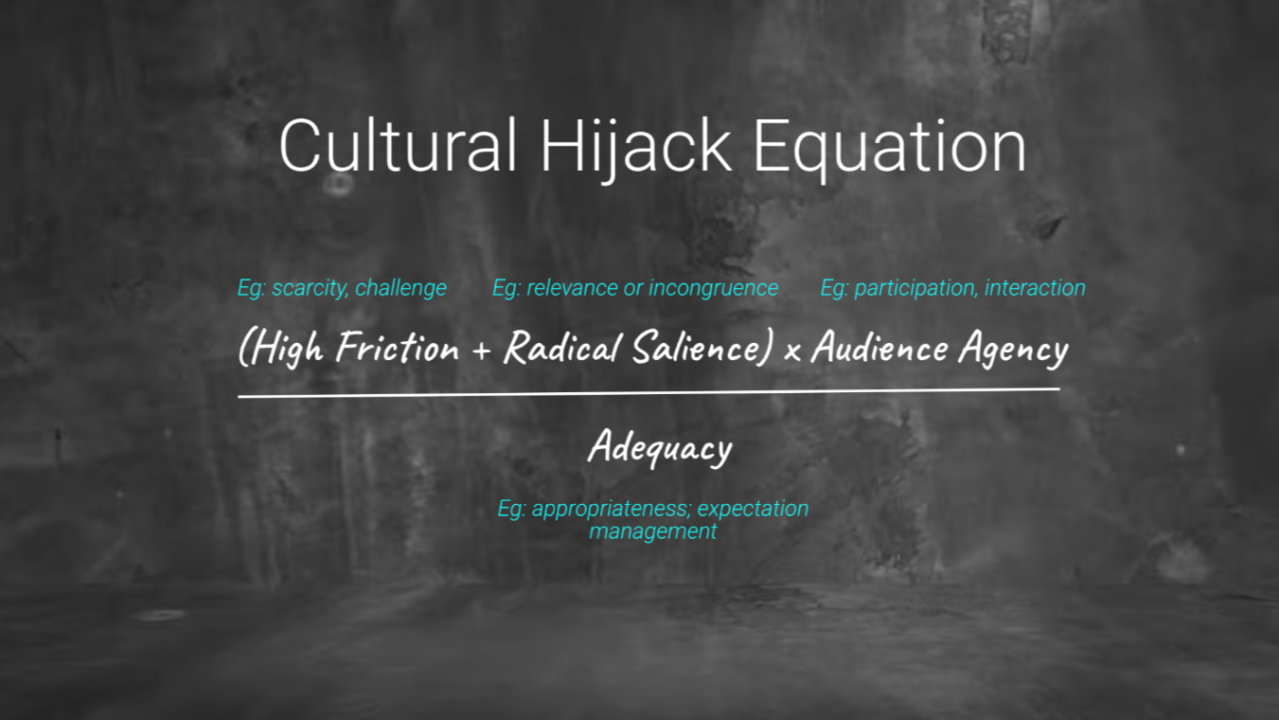
Charlotte boiled it down to a simple formula:
(High Friction + Radical Salience) x Audience Agency, divided by Adequecy
Now, as most of us haven’t done formulas since GCSE, let’s show her working:
- High friction: strategic friction (i.e. consumer effort) can psychologically increase the perceived value and memory of a brand experience.
- Radical salience: an activation must either connect with a specific subculture or stand out through unexpected environmental contrast.
- Audience agency: true engagement shifts people from passive consumption to active ‘storydoing,’ i.e. becoming physical heroes within the brand’s narrative.
- Adequacy: whatever the experience, a disruptive stunt, guerrilla moment or cultural on-point partnership, it must authentically align with and execute your core brand values, ensuring audacity remains appropriate rather than just noise.
THE SIX PROVOCATIONS (REWRITING THE RULES OF ENGAGEMENT)
To bring this formula to life, Charlotte presented six provocations designed to challenge our traditional marketing biases and help brands successfully command attention.
- Convenience is the enemy of memory: Modern marketing is obsessed with removing friction, but making an experience totally seamless also makes it totally forgettable. Leaning into the IKEA Effect, Charlotte explained that forcing audiences to invest effort (queuing, solving a puzzle, hunting down a “hype drop”) increases the perceived value of an experience and cements it in long-term memory. [The Hijack: Stop making it easy; start making it an achievement.]
- Design for the feeling, not the “For You” page: Brands frequently demand that agencies build an activation that will “go viral”. Ho hum. We all know virality cannot be mathematically engineered. What can be engineered, however, is emotion. Highly shareable moments are driven by triggers such as shock, surprise, joy, or even horror because they are real emotions that hardwires us to share content. [The Hijack: You can’t engineer viral, but you can engineer goosebumps.]
- Participation is the new persuasion: Traditional campaigns rely on pushing a brand’s narrative, but modern cultural relevance instead requires a kind of ‘value exchange’, one that invites active engagement and harnesses the Generation Effect, in which consumers remember information better when they generate it themselves. [The Hijack: Shift from storytelling to storydoing and make the audience the hero of the moment.]
- Stop trying to be consistently good; be briefly incredible: Humans simply cannot process the sheer volume of daily marketing noise, meaning they are never going to remember every single detail of an event. Citing Daniel Kahneman’s ‘Peak-End Rule,’ Charlotte emphasised that an audience’s memory of an experience is entirely dictated by its most intense emotional peak and how it finishes. [The Hijack: Design the emotional spike first, and build everything else around it.]
- Playing it safe is your riskiest option: To grab attention, brands need the courage to break category norms and stand out from their surroundings. This relies on the ‘Von Restorff Effect’ (or isolation effect), which shows that an item that noticeably differs from its surrounding context is the one most likely to be remembered. [The Hijack: Stand out or stand down by creating something impossible to ignore.]
- Design for the 90% Who Can’t Get In: While physical footfall and engagement matter, digital eyeballs matter more. A successful build must be treated as a high-powered media asset and a content engine. When an experience resonates deeply, the brand’s community will organically amplify the campaign across their own social feeds, DMs, and WhatsApp groups and these communities are often a bigger amplifier, than the paid media media [The Hijack: Don’t just build a physical space; construct a content engine for the wider world.]
PART 2: THE ROUNDTABLE (SEWAGES, SNEAKERS AND ART GALLERIES)
Following these provocations, we got stuck into a roundtable discussion, designed to bridge the gap between behavioural theory and real-world execution. The panel featured Charlotte Lewis from Channel 4, Michael Boaler, EMEA Head of Marketing & Global Media at Dr. Martens, and Serge Vaizi from Seven Communications, who joined forces to share real-world insights on balancing creative bravery with brand identity. As ever, there were plenty of highlights.
Channel 4’s “Fountain of Filth:
When Channel 4 launched a drama on the UK sewage scandal, they knew a standard trailer wouldn’t cut it. Test screenings left viewers genuinely shaking with rage, and recognising this rawness, Charlotte Lewis bypassed typical billboards to create the ‘Fountain of Filth,’ a striking installation on the River Thames depicting lifelike figures of real grassroots activists vomiting polluted water. By tapping into a real human truth, backing it with rock-solid legal vetting, and turning anger into public art, the campaign caught fire. It grew from a TV promo into a national political movement, even landing debate time in Parliament.
Dr. Martens and the power of “The Buzz”
To maintain cross-generational relevance without losing its (sole?) soul, Dr. Martens anchored its latest activation in its core pillars of craft, comfort, and confidence. It did so while adapting the delivery mechanism to Gen Z’s desire for self-expression and shareable moments. Michael detailed how they launched an entire product franchise via ‘The Buzz Bus,’ a striking mobile installation that toured London, distributed shoes, and culminated in a highly shareable, organic collaboration with musician Lola Young at the Kentish Town Forum.
Challenging norms with Seven Communications
Serge Vaizi of Seven Communications talked about how cultural hijacks require the audacity to disrupt expectations and subvert everyday habits. For the luxury travel brand Plum Guide (“a bit like Airbnb, but really posh”) who don’t allow reviews of their properties, his agency bypassed traditional travel press by projecting hilariously brutal, real one-star TripAdvisor reviews onto iconic landmarks like the Tate Modern (“it should be called the Tat Modern”) to show that reviews are by their nature subjective anyway, and not always to be trusted! Plum Guide quickly became front page news.
MEETING “OSCAR”: QUANTIFYING CULTURE VIA AI
To overcome the hurdle of proving the commercial performance and ROI of these brave, disruptive ideas to corporate financial directors, Serge unveiled ‘Oscar’ (Observational Strategic Cultural Assessment and Recommendation), a cutting-edge AI agent, whose tone of voice also happens to be inspired by his illustrious namesake, Mr Wilde. This new tool provides a data-backed foundation for creative risk by scoring a brand’s fluid cultural intelligence based on organic, real-world footprints such as earned media, social listening data, and spontaneous citations in music, books, and film. There is plenty more to talk about there, and if you’re interested, you should check it out here.
In summary, the era of the ‘polite’ campaign is over.
In a world drowning in noise, safety is the most dangerous strategy. If there was one thing our ‘Cultural Hijack’ event proved, it is that true cultural resonance doesn’t come from safe, seamless messaging: it comes from bold, brave, cultural moments. By trading passive storytelling for active ‘storydoing’ and replacing convenience with friction, whether through the deliberate provocation or the organic buzz of a pop-up tour, the goal remains the same: stop trying to be consistently good. Instead, start being briefly unforgettable.
Are you ready to hijack culture? Let’s make something worth talking about. 📩 anton.jerges@wearecollider.com